

The Future of Software Engineers in the Age of AI
Why This Question Is Being Asked Today
Students studying Computer Science and early-career developers are increasingly asking an important question:
If AI can write code, what will software engineers do in the future?
This concern is understandable. Modern AI tools can generate functions, write unit tests, suggest architecture patterns, and even debug programs.
Tasks that once took hours can now be completed in minutes.
However, history shows that automation rarely eliminates technical professions. Instead, it transforms them.
Programming itself has evolved repeatedly - from assembly languages to high - level languages, from manual memory management to powerful frameworks.
Each wave of abstraction made developers more productive and increased the scale of software systems being built.
What AI Is Good At Today
Modern AI systems are extremely good at pattern recognition and code synthesis. Since large language models are trained on vast codebases, they can generate code that closely resembles what experienced developers would write.
AI excels at:
- Boilerplate CRUD APIs, tests, simple scripts
- Translating specs into first-draft code
- Explaining code and suggesting fixes or refactoring improvements
- Generating documentation
- Implement common algorithms
- Convert code between languages
These capabilities dramatically speed up development workflows. Instead of writing repetitive code manually, developers can focus on higher-value engineering tasks.
Where AI Still Struggles
Despite impressive progress, AI still has several critical limitations.
AI struggles with complex system design.
Large-scale software systems involve distributed components, infrastructure decisions, and long-term architectural planning. These require deep contextual understanding that current AI systems lack.
AI cannot fully understand business context and constraints. Real-world software projects involve ambiguous requirements, stakeholder discussions, and trade-offs between performance (security vs speed), cost, and usability (simplicity vs flexibility).
AI-generated code often requires careful validation. Security issues, logical edge cases, and performance bottlenecks can still occur.
And More ...
- Incomplete, shifting requirements
- Long-term architecture and technical debt
- Human navigation (PMs, clients, teams)
For these reasons, human engineers remain essential.
What's Actually Changing?
First, we have to be honest about the shift. Denying its impact is a recipe for irrelevance.
Coding is becoming a commodity. Writing basic boilerplate, implementing standard algorithms, and fixing common syntax errors are tasks AI can do instantly. The value of a programmer who can only write code that an AI can also write will diminish.
The '10x engineer' multiplier. Tools like GitHub Copilot already make competent engineers vastly more productive. They act as an intelligent pair programmer. The engineer who masters these tools will be far more effective than the one who doesn't.
Shift in focus, not elimination of jobs. The demand for software isn't decreasing; it's exploding. AI lowers the cost of creation, leading to more software being built. The job is shifting from manual code writing to orchestrating and managing complex systems.
What AI Can't Replace: The Enduring Value of a Human Engineer
If AI can write code, what do you bring to the table? Everything that AI fundamentally lacks.
Problem decomposition & requirements gathering.
A client says, I need a system that notifies users when their order is delayed.
AI sees a function to send an email. You understand the need to define delayed, check user preferences, handle batching, integrate with order management, and comply with privacy laws.
Systems architecture & holistic thinking. AI is great at writing a function, but terrible at designing a scalable, secure system.
You understand trade-offs: relational vs. NoSQL, monolithic vs. microservices, handling eventual consistency.
Debugging complex, interconnected failures. When a system breaks, the error message is rarely the cause. You trace the path through dozens of services, identify race conditions, memory leaks, or misconfigurations.
Deep business & domain expertise. A fintech engineer understands financial regulations; a healthtech engineer knows HIPAA. This knowledge is hard-won and impossible for a general-purpose AI to replicate.
Ethical judgment, security, and risk assessment. AI can generate code with known vulnerabilities. You are the final line of defense, asking, 'Is this safe? What are the potential misuse cases?'
Collaboration, communication, and leadership. Explaining technical concepts to stakeholders, mentoring juniors, and leading projects are purely human skills that become your primary source of leverage.
Why Fundamentals Matter More Than Ever
AI often hallucinates or produces Leaky Abstractions. A junior engineer who doesn't understand Memory Management or Big O Notation will blindly accept AI code that crashes in production. You need to be the 'Judge' of the code, and you cannot judge what you do not fundamentally understand.
Mastering the AI-Augmented Workflow
The goal isn't to work against AI, but to use it as a 'Junior Developer' under your command. Learn to provide Context. Great engineering is about how well you can define System Constraints, Security Boundaries, and Edge Cases within your prompts.
The Mindset Shift: Coder → Engineer
Stop thinking "I write code." Start thinking "I engineer solutions."
This means:
- Code becomes one tool among many
- Deep problem understanding before keyboard touch
- Ownership of reliability, security, performance
- Comfort saying I don't know; let me investigate.
The Real Transformation of Software Engineering
The biggest change introduced by AI is not the elimination of developers but the transformation of their workflow.
Traditionally, developers spent large amounts of time writing low-level code. In the emerging AI-assisted development model, engineers instead guide AI systems to produce code and then evaluate, refine, and integrate the results.
In this new model, engineers act more like architects and editors than manual coders. They define the problem, instruct AI tools, validate the outputs, and ensure the final system meets quality standards.
Anti-Fragile Technical Foundations
These skills make AI output better , not obsolete you:
- Data Structures & Algorithms (arrays, trees, graphs, sorting, DP)
- Systems (memory, CPU, processes, threads, concurrency)
- Networking (HTTP, REST, TLS, latency sources)
- Databases (SQL, indexing, transactions, NoSQL basics)
- Architecture (modularization, design patterns, dependencies)
- Git & collaboration (branching, PRs, code review)
Master AI as Your Power Tool
Treat AI like a Super IDE, not magic:
- Prompt precisely : Include constraints, framework, performance targets
- Iterate ruthlessly : "This fails for X. Make it O(n log n). Add edge case tests."
- Validate ruthlessly : Does it handle failures? Scale? Secure? Readable?
Skills That Will Become More Important
As coding becomes partially automated, several skills will become even more valuable.
Problem-solving ability remains the most important skill. Engineers must still understand algorithms, computational complexity, and system behavior.
System design is becoming increasingly critical. Large-scale platforms require knowledge of distributed systems, cloud infrastructure, and scalability principles.
Engineers must also develop AI literacy. Understanding how machine learning systems work helps developers effectively integrate AI capabilities into applications.
Communication and collaboration skills are essential. Software development is a team activity that involves stakeholders, designers, and product managers.
The Rise of AI-Augmented Engineers
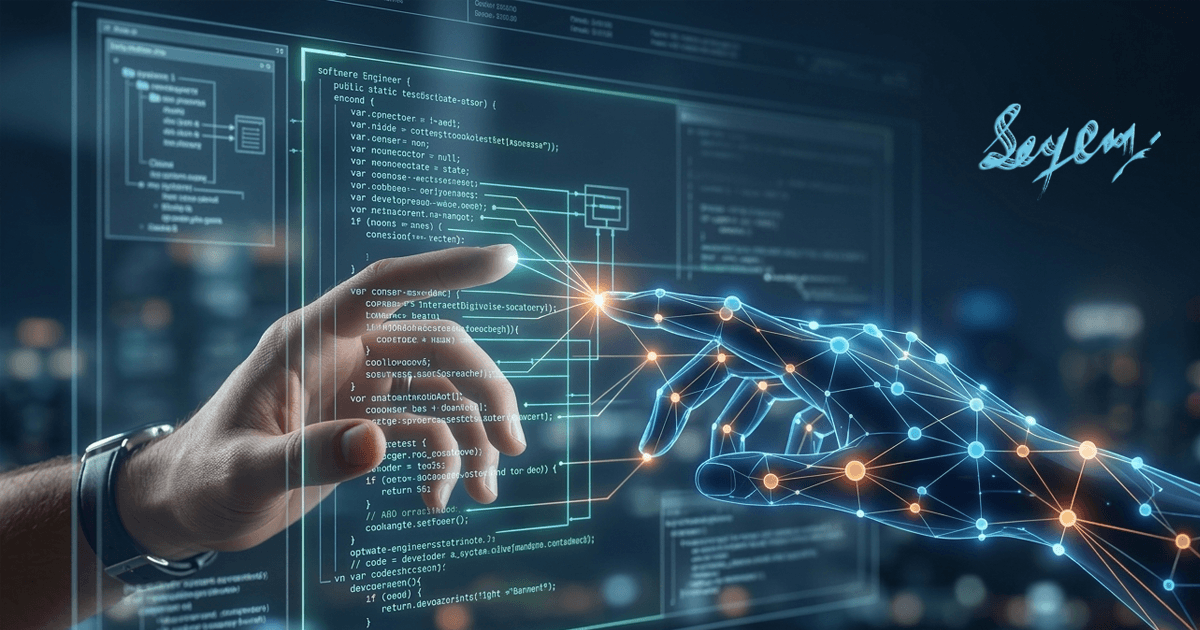
The future developer will not work alone. Instead, engineers will increasingly collaborate with AI systems as intelligent assistants.
This concept is often referred to as AI-augmented development. Engineers who effectively leverage AI tools can dramatically increase their productivity.
For example, an engineer might design a system architecture, ask an AI tool to generate service templates, refine the generated code, and then integrate the components into a complete system.
In this sense, AI becomes a force multiplier rather than a replacement.
How to Prepare: A Practical Guide for Your Career
Your university education is your foundation. Now it's time to build the house.
Phase 1: Fortify your core. Master data structures, algorithms, operating systems, computer networks, and database design. This deep knowledge lets you critically evaluate AI's output. Learn multiple programming paradigms to develop a flexible mental model.
Phase 2: Embrace the new tools. Use GitHub Copilot, Amazon CodeWhisperer, or similar for all your projects. Learn prompt engineering for code: be precise, ask for explanations, and always review every line of AI‑generated code.
Phase 3: Level up your human skills. Study system architecture (e.g., 'Designing Data-Intensive Applications'). Practice writing clear technical specifications.
Understand the business side of your industry: finance, healthcare, logistics.
Develop product sense: why is a feature built one way and not another?
Phase 4: Specialize in AI-resistant niches. Cybersecurity (AI creates vulnerabilities faster than it fixes them), embedded systems & IoT (real-time constraints, hardware interaction), legacy system modernization, and high‑performance computing (optimising for specific hardware) are areas where human expertise remains indispensable.
The Road Ahead
The future for software engineers is not about becoming obsolete; it's about becoming augmented. The role is evolving from coder (a constructor) to solution architect (a designer, problem‑solver, and orchestrator).
To succeed, you need to be a T-shaped professional:
- The vertical bar is your deep foundational expertise;
- The horizontal bar is your broad understanding of business, communication, systems thinking, and ability to leverage AI tools.
By investing in your uniquely human capabilities and using AI to automate the mundane, you won't just survive the AI revolution - you'll be in higher demand than ever, leading the charge in building the next generation of technology.
The Three Pillars of Indispensability
To remain relevant, focus on:
1. System Design (How parts connect),
2. Observability (How to find why things broke), and
3. Domain Expertise (Understanding the business problem better than the LLM does).
Building for the Global South
Operating from hubs like Dhaka, our advantage is our resilience and talent density. But global trust is built on Quality. Use AI to bridge the speed gap, but use your human intuition to ensure the architecture is resilient, secure, and context-aware for the markets we serve.
"The future does not belong to engineers who compete with AI. It belongs to engineers who learn how to collaborate with it."
"AI can generate the code, but it cannot take the responsibility. Wisdom is the bridge between a working script and a resilient system."